After reviewing her chart, noting her age (81), "medical co-morbidities" as we like to call them, and medication list (only 2 inhalers for her lung disease), I went in to see Ms. Hip*. As I approached her room, I was thinking about the things that would make her a "good" or "bad" surgical candidate along with the things we should be concerned about during the pre-op and post-op periods.
Ms. H.'s Surgical Risks:
- Advanced age
- Extreme malnutrition: Ms. H. weighs ~90 pounds and is severely malnourished because she hasn't been able eat due to esophageal stricture. She receives 5 cans of Ensure daily through a J-tube (feeding tube directly into the jejunum, or first part of the small bowel).
- Bad lung disease: Emphysema. COPD. 2 hospitalizations since December for aspiration pneumonia. Patients with poor lung function don't recover very well from surgery because they don't have much "reserve" and generally don't tolerate general anesthesia with intubation as well (it's actually more difficult to get them off the ventilator after an operation more than anything). They are more prone to complications such as COPD exacerbations, developing hospital acquired pneumonia, and poor wound-healing secondary to lower oxygen levels in their blood.
- Anemia: Hematocrit of 27 (normal: 40-45). This is a concern if there is excess surgical blood loss and the ability to maintain adequate perfusion of vital organs (i.e., not getting enough blood to the brain can cause an ischemic stroke) among other things.
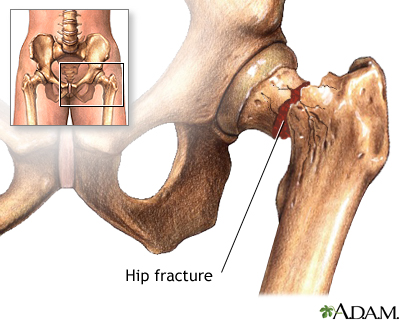
- Most importantly, the broken hip: Before I was in medical school, I guess I'd never really thought about what exactly a broken hip was. I just figured it meant that you broke your pelvis bone or something. For example, if someone asked me to point to my hip, I'd have pointed to my anterior superior iliac spine (I know, sounds fancy...they like to teach us big words in medical school). Last year I learned that when a person breaks their hip, it actually means that they have broken the top of their femur bone. Hip fractures are more common in older people and carry a 30% one-year mortality rate (one of the highest mortality rates of any acute medical condition/surgery). It's not that the actual hip fracture or surgical repair itself is particularly risky, it's just that a hip fracture is a marker of poor health. That is to say, people who get hip fractures are in poorer health than those who don't get hip fractures, so naturally, they have a higher rate of mortality.
- No history of heart disease or failure.
- No history of renal disease or failure.
- Minimal medications.
- Surgery
- Surgery
- Surgery
- Medical management: Appropriate only if life expectancy is less than one month. Consists of pain management and treatment of other medical problems. Studies have shown that if patients are expected to live longer than one month, despite their hip fracture, it is best to go ahead with surgery and try to get them as healthy as possible.
I entered Ms. H.'s room and performed my detailed history and physical exam. I don't need an "MD" behind my name just yet to say that in even just looking at Ms. H., I knew she wasn't a great surgical candidate. Honestly, I didn't even need to set my stethoscope on her chest to tell you the findings of her lung exam: increased work of breathing with minimal air movement, inspiratory and expiratory wet crackles in all lung fields bilaterally. There was a specimen cup on the bedside stand half-full of thick yellow-green sputum: this was normal for her.
She would chuckle a raspy laugh as I asked her questions like, "how long have you had your cough?" and "what makes you feel like you can't catch your breath?". I felt silly asking these routine questions when I knew how they must have sounded rhetorical. I know she was laughing at my questions, but she was sweet and just said, "oh honey, I don't know". When I asked her what happened, she said she had gotten up in the night to go to the bathroom and when she returned to bed, she "just misjudged the distance to the bed" and fell. Immediately, her right hip and leg were in pain and she was brought to the hospital that morning. She said she wasn't in much pain now and that she was as comfortable as she could be.
I explained that she would probably need surgery and that Dr. Cuskelly and myself were going to be looking after her medical issues during her hospital stay. I told that we were concerned about her lungs and wanted her to practice deep breathing with the incentive spirometer and continue to use her inhaler and oxygen. I informed her and that we were getting routine chest x-rays, and running sputum, blood, and urine cultures to check for any signs of infection so that we could treat those before she became symptomatic. I also let her know that we were concerned about her anemia and malnutrition. We could not feed her until after the surgery, but we would give her 2 units of pRBCs (packed red blood cells) now and make sure the dietitians saw her and made recommendations for us.
She indicated that she understood, then I told her I needed to clarify one more thing with her: "Ms. H., I need to know what you would want us to do should your heart stop or if you stopped breathing on your own."
"Just let me go. I don't want CPR. Everything else, just no CPR."
I was confused. I didn't know what she meant by 'everything else'. "Okay, Ms. H. I just want to make sure we are understanding each other. I know you don't want CPR, or chest compressions, if your heart stops," I made the hand motions on my own chest, "but what about if your heart is still beating and you stop breathing?? Would you want us to intubate you? I mean, to breath for you or put something down your throat to help you breath? I am only asking because I want to make sure we do what you want. Do you understand that CPR is different that ventilation?" Again, I was making hand motions; this time to my mouth and throat mimicking intubation.
It then occurred to me that in just 2.5 short years I was already beginning to speak the foreign language of doctors that separates them from patients (keeping in mind that this is a very basic example...fairly straight-forward and relatively easy to clarify without too much jargon, but none-the-less a hurdle we must overcome). We write DNR/DNI (do not resuscitate/do not intubate) orders every day. Those abbreviations mean two very different things to us, but to a patient (or any non-medical person), it's all just CPR. And what exactly does "CPR" mean to any non-medical person? That may have a variety of different meanings to different people. And then to confuse matters worse, we start using words like "intubation" and "ventilation" to folks that are 1) sick, under stress, and possibly confused, and 2) elderly and hard of hearing...not the most ideal setting for making informed decisions. How do I know that what I am saying is what she is understanding? Or what she is saying is what I am hearing? And how do all these issues of semantics impact the doctor-patient relationship? Am I inadvertently adapting the "us and them" mentality that so many river guides use to intentionally separate themselves from guests?
"Oh, honey, I don't want anything that has to be long term. No CPR. No tubes if it has to be for a long time. If it's my time to go, then let me go. I'm ready."
"Okay, I understand." I said as I gently patted her leg, held her hand and mentally wrote down "DNR/DNI".
____________________________________________________
The next morning I went in to check on her. She looked the same, but her lungs sounded worse. I told her the surgery would probably happen in the afternoon and that I would be there for it and, although I wouldn't be in the hospital through the weekend, that Dr. Cuskelly and myself would be looking after any medical issues she might encounter after the surgery. She chuckled her wet laugh and said, "That's good. I like Doctor. He's a good man."
"Yes, he is," I agreed, "and a good doctor." In the back of my mind I wondered if she would be around when I returned to the hospital Monday. I don't mean to be morbid, cold, or insensitive, I just didn't think she had a lot of "reserve" to tolerate the stresses of a surgery and I wasn't going to lie to myself about her prognosis.
____________________________________________________
That afternoon I saw my first orthopedic surgery. I waited with Ms. H. outside the OR for Dr. Urvater to arrive. I held her hand and asked her how she was going. It was difficult to understand what she was saying: her lungs were sounding worse. The coughing and airway congestion were interfering with her speech. She looked scared and asked one of the nurses to pray with her, but this didn't bring her heart rate down. When Dr. Urvater arrived, we went into the OR, got her prepped, and anesthetics started. This operation might normally require general anesthesia, but because of her poor lung function and inevitably difficult post-op extubation, a local spinal block was used along with sedative narcotics for pain and amnesia.
Dr. Urvater is married to Dr. Camber, but while she is very outgoing and bubbly, he is very level and restricted. I guess opposites attract. This isn't to say anything bad about him: he's very nice and also willing to teach me, just with a little less enthusiasm, I guess. Anyway, it was amazing to see this operation. A small incision is made on the upper outer thigh. The layers of muscles are dissected away to reveal the trochanter of the femur broken away from the head. The head is taken out and the shaft of the femur sawed down. Prosthetic components (ball and socket) are measured and fitted. Marrow is taken out of the shaft, inner diameter is measured, cement is mixed, and it's all put back together. (Note: this is a very simplified description...I left out a bunch of technical stuff and lots of hammering and chiseling).
Through the operation, her heart rate remained elevated, but she otherwise did well. No problems with breathing or maintaining O2 saturation. I visited with Mark, the anesthetist for a long time afterwords. He was teaching me about different medications and concerns he was watching for in the post-op hours. He confirmed that she was high-risk and that he was concerned; he would be keeping a close watch on her.
When I left the hospital Friday, I felt better about her outlook. Things went well in the operation: no surgical complications, no lung problems, no need to intubate her for anesthetic purposes, minimal blood loss, no heart problems, no blood pressure problems. I was actually pretty optimistic. I called Aaron and told him about the surgery and I was excited to have the privilege to care for Ms. H. and also see her surgery.
____________________________________________________
I was called in by Dr. Ercanbrack, the general surgeon, this morning to assist on a appendectomy. When I arrived to the OR I saw Mark, the anesthetist: "So I guess you probably heard by now that Ms. H. died yesterday."
I hadn't heard. "No," I said, "that's too bad." And it was. I felt my heart drop a little, but I wasn't surprised, just sad and disappointed to hear it.
Then there is always the questioning: Did we do the right thing? What could we have done differently? Did I miss anything? Should we have provided "comfort care" rather than perform surgery? Medicine is a scientific field: we like patterns, certainty, predictability, and answers. But it is also an art: a balancing act where we consider each patient as an individual and every situation is different without right, wrong, or clear decisions and answers. I'm learning that at the end of the day, we can't question our decisions to the extent that we become paralyzed. We must trust our knowledge, training, clinical judgement, and experience to guide us in making the right decision, and as Bob Campbell used to tell me before a kayak race, "let the results take care of themselves". Experiences such as this makes me appreciate the seemingly endless hours and years of studying and training it is taking me to get those two letters behind my name: it's so that I will one day have the knowledge, training, clinical judgement and experience necessary to guide me. I will have to learn to trust my decisions and live with unanswered questions because I won't always know "what if..."
___________________________________________________
*for patient confidentiality purposes, I will use pseudonyms when I recount patient stories



No comments:
Post a Comment