I was holding off posting about STOKR until I was sure that I would be woman enough to do this...
The Scenic Tour Of the Kootenai River (STOKR) is a two day road bike tour through the area that is put on every mothers day weekend. It is organized by Dr. Rice's wife, Susie (road biking is sort of Dr. Rice and Susie's "thing"). There are a limited number of riders: 400. That actually doesn't sound too limited to me...I can't imagine what it will be like to start a ride with that many people...but apparently Susie has to turn a lot of applicants away and she does so with a lottery system.
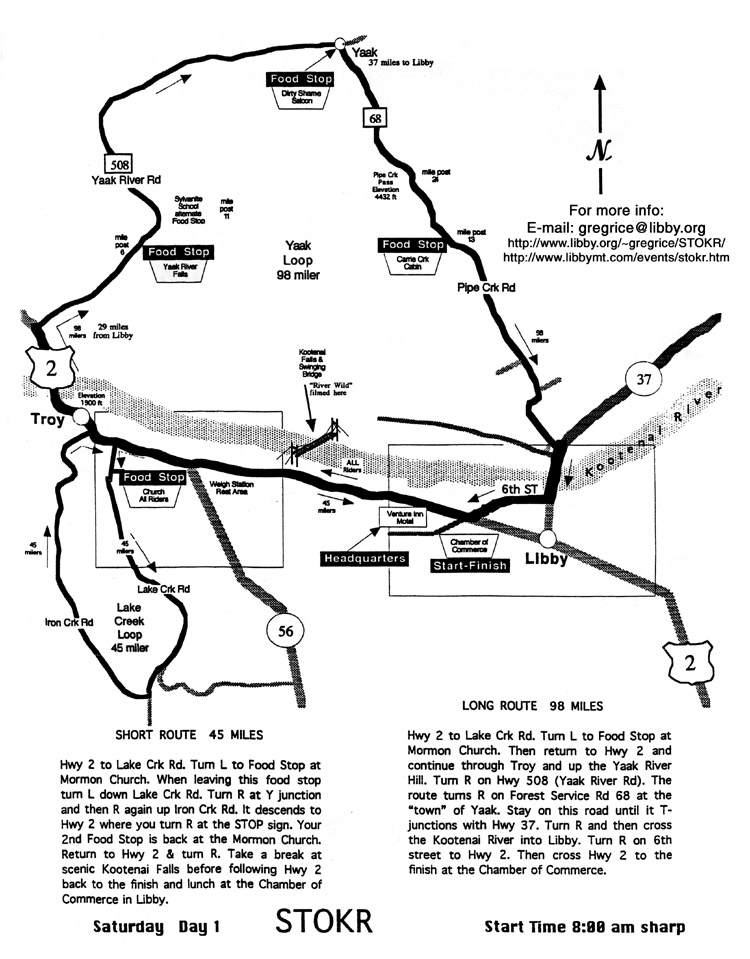
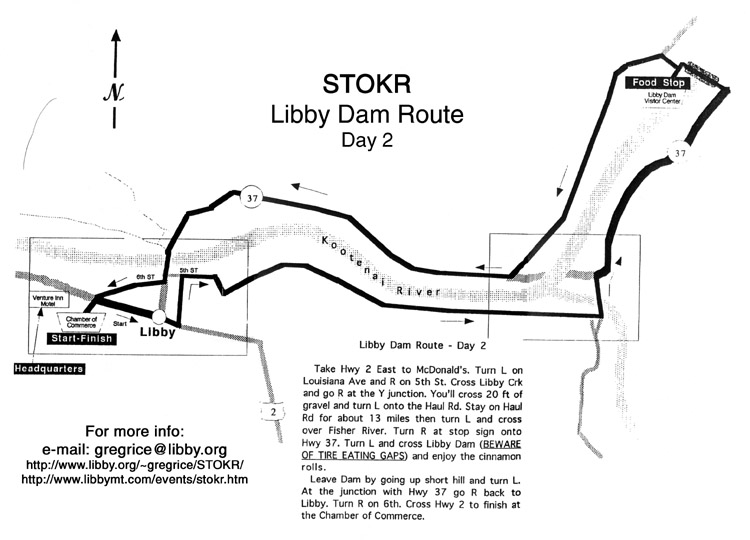
In February, Susie was telling me all about the race (excuse me for calling it a 'race'; I've already been corrected several times that it's not a race, but rather a tour--I guess it's my competitive nature coming out when I keep calling it a race). She told me about how on Saturday, riders start in Libby, ride to Troy (~18 miles) where the first food stop is at the Mormon church with bagels and juice. From there, the tour continues down river for a few miles before taking a sharp right-hand turn up the Yaak River Road until the next food stop (I can't quite remember what food is at this stop...I want to say donuts, but that really doesn't make that much sense to me) at the Sylvanite School (~22 miles). The ride continues to follow the Yaak River upstream to the town of Yaak (~21 miles). This is the "longest" food stop where riders are served submarine sandwiches to fuel them for the next leg which goes over Pipe Creek summit (~16 miles...all uphill). Once riders get to the summit, they can stop for some water and GORP before finally heading downhill for the last two legs of the ride (~21 miles). The last 'fuel' stop is about 15 miles from Libby where riders indulge in a variety of homemade pies made by the little-ol'-ladies of Libby. By my calculations, that's a 98 mile ride! The Sunday ride is a mere 34 miles from Libby out to Libby Dam and back.
As Susie was telling me all about the tour, my only thought was, "Man, you'd have to be crazy to do that!" That's 132 miles in two days and a lot of hill climbing, which for a kayaker/rafter, really sounds daunting.
Susie then proceeded to tell me that the ride was a benefit for raising funds for Habitat for Humanity. Every other year, the funds from two years of the tour are used to pay for building materials for a Habitat house. Riders even have the opportunity to help with the building project on the two days prior to STOKR. This year, the house is to go to one of the Libby Clinic employees, Rhoda, who is a lab technician. She apparently had some unexpected family problems and medical bills pile up last year and has had difficulty making ends meet. This made the whole idea of the tour seem even cooler to me...what a neat way to make a difference in someones life and let a lot of people come together and have a good time trying to kill themselves on a bike for two days!
Susie then told me, "Well, it is a lottery, but because I'm the one in charge, I always hold a few slots back for 'special' people and friends [A-ha! I always knew lottery systems were rigged...I honestly think this is how the Green boys get permits EVERY YEAR on the Selway]. Would you like one of those spots?" Because Dr. Rice and Susie are such avid riders, I assumed that all WRITE students here do the tour. In my mind, it was sort of an expectation or a 'requirement' of the rotation just like passing an exam is or taking call once a week. Susie's 'question' on if I wanted one of the spots was more like a statement: "You will ride in STOKR if you expect to pass the rotation."
I certainly didn't want to let her down. I tried to fake enthusiasm so that my clerkship grade wouldn't get docked, "YES, that would be fun! I don't ride, but it'll be good motivation for me to get in shape."
"Oh, no" I thought. "What did I just commit to?? I've only ridden my bike to school and back in Seattle and I'm huffing and puffing even at that!"
Needless to day, I paid my entry fees, signed up to volunteer on the house building, and pumped up the tires on my bike.
So...I've been 'training' for the last 3 weeks. Dr. Rice recommended getting in 200 miles before the race and one 50-mile ride to prepare. Yesterday, I'm pleased to say, I hit the 200 mile mark (210 actually) after finishing my first 50-miler! I'm pretty proud of myself. When I first started training, I didn't think I would be able to make it: My first few rides were only 16 miles and I was wiped out. I've gradually worked up to longer rides and learned how to be more efficient on the bike. I think that in the beginning, I was trying to go too hard and "going lactic" right off. Dr. Rice and I rode together last week and he gave me great tips about "spinning" to avoid running out of steam too early in the ride.
So, wish me luck on the rest of my training...now that I've hit the 200 mile mark, I think I'll try to get another 100 in. I want to get some more hill riding in (the ride on Saturday has a 2395-foot elevation gain!); I'm planning on doing a summit ride sometime next week. I'll keep you posted and let you know how the "race" goes!
Oh, and as a side note, I was told last week that I am only the second WRITE student that has entered the ride! So much for my misconception about it being a requisite for passing grade in the rotation...maybe it'll get me 'honors'!
Thursday, April 23, 2009

Tuesday, April 14, 2009
Becoming a Doctor
Dad sent me this link for the NOVA program, "Doctors' Diaries". I can really relate to this, although I don't think I'm quite as inept as some of them (and they are Harvard students!)...of course I am egocentrically biased of my performance.
The Art of Pimping
A lesson in being a medical student being put in the line of fire. This is an article from JAMA (Journal of the American Medical Association) that one of my classmates emailed to the class. I couldn't link directly to it because it is password protected, so I hope this is somewhat readable in the cut-and-paste format.
The Art of Pimping
Allan S. Detsky, MD, PhD
THE TERM “PIMPING” WAS POPULARIZED BY BRANCATI1
in 1989. As he defined it, pimping occurs when
an attending physician (the Pimper) poses a series
of difficult questions to a resident or medical student
(the Pimpee). Pimping usually occurs in settings
such as “morning report” or “attending rounds,” in which
trainees at various levels convene with a faculty member to
review patients currently under their care. Among surgeons,
pimping may occur when students and residents
are a captive audience observing a patient undergoing an
operation. Brancati1 described the origins of the term,
which date back to 17th-century London. Koch’s series
of “Pümpfrage” (pimp questions) were used on his rounds
in the 19th century. The practice migrated to North
America in the 20th century and was documented by
Flexner while observing Osler making rounds at Johns
Hopkins. Brancati1 outlined suggestions for attending
physicians to further hone their pimping skills and
methods for students to defend themselves from it. He
posited that the art of pimping would disappear in the
future with increased specialization and educational
reorganization. This Commentary revisits the art of pimping
20 years later and provides an update for faculty
members and students alike on modern methods in this
important skill.
Pimping is indeed alive and well within academic medicine
for several reasons. First, the basic structure of medical
teaching has not changed. Ross and Detsky2 have described
the teaching services at 2 academic hospitals on both
sides of the Canada/US border. Students and residents still
work up patients and report to attending physicians as much
in 2009 as they did in the last half of the 20th century. Faculty
still meet with small- to medium-sized groups of medical
students and residents and use interactive methods that
somewhat resemble Socratic techniques. Second, the power
relationship between teacher and student still exists and likely
always will, because the teacher has more content knowledge
and is responsible for evaluating the students. Pimping
reinforces that power relationship because the teacher
usually controls the questions. The teacher likely knows the
answers while the students may or may not. A historical example
of the effect of this phenomenon was described by
Ausiello in a brief biography of Their.3 When Their was chair
of medicine at Yale, a resident once fainted from anxiety prior
to a case presentation. This experience resulted in giving
Thier the nickname “Syncope Sam.” The third reason pimping
has flourished is the explosive expansion of the knowledge
base in clinical medicine.
Advice for Students (the Pimpees)
Clinical teaching sessions often involve direct questioning
of individual students in the presence of their peers. This
differs from most examinations in which the student’s
knowledge base is not on public display. In some cases,
participants volunteer answers. More often, the faculty
member selects 1 or more of the participants to respond. If
the first student cannot correctly answer, another student
is chosen, and so on until someone answers the question
correctly. If no one answers the question correctly, the
attending does (assuming he or she knows the answer). If
not, a student is usually assigned to investigate the question
and report back the next day. Some students thrive on
displaying their knowledge (or lack thereof ) in public,
others do not.
For students, there are several techniques to protect against
being pimped. (see below in yellow text)
Pimping Protection Procedures
Avoidance
Do not have visual contact with the teacher. There are several
variations of this technique including (1) “eclipse” (make sure
that another person’s head is always in the direct sight line between
student and teacher); (2) “camouflage” (the student sits
very still, hoping the attending does not notice him or her);
and (3) “meditation” (the student lowers his or her head, leans
slightly forward and puts the palms of the hands together).
The Muffin
This technique is particularly useful for senior residents who
are fearful that the attending physician will embarrass them with
a question they should be able to answer but cannot. The resident
holds a large muffin in the dominant hand with the elbow
flexed, and slowly makes motions with the elbow that move
the muffin toward and away from the mouth, somewhat like
the graphical lines representing the attitudes of focus group
members used by television networks while watching the recent
presidential debates (ie, closer to the mouth if the resident
does not know the answer, further if he or she does). If
the resident feels that the teacher will call on him or her to answer
a question to which he or she cannot respond, the muffin
should be placed into the mouth. Most attendings will not ask
residents or students to speak with their mouth full of food. If
the attending does, the resident should pretend to choke, thus
avoiding all future questions.
The Hostile Response
If a student is singled out to answer and is embarrassed because
he or she cannot, the student should be sure to respond
in a hostile fashion, both with the tone of voice and body language.
Most teachers will refrain from asking that student questions
in the future. An answer that always works is “I don’t
know,” with a 1-second pause between each successively louder
spoken word.
The List
If a list of answers is being compiled from several students (eg,
what are the life-threatening causes of chest pain?) and the student
does not have one, the student should just repeat the response
given by a previous respondent and pretend he or she
did not hear it. This is particularly effective if the student
holds the patient list in front of him or her and looks like
he or she is preoccupied with patient care responsibilities.
The student or resident can amplify the sympathy by constantly
checking his or her pager. (Who can blame anyone
who puts patients first?)
Honorable Surrender
Tell the teacher you are uncomfortable. Few students try
this, but sometimes the direct approach is best. Those who
are uncomfortable being put on the spot in public should
just say so. This can be done in the presence of the group
or in private after the teaching session.
Pimp Back
The student or resident should find a knowledge area in
which he or she has a comparative advantage over the teacher
and turn the tables on him or her. In the era of increased
subspecialization in which the teacher may not be familiar
with the patient presented, this is not as difficult as it sounds.
However, pimpers usually do not like to be pimped so be
careful.
The Politician’s Approach
Do not answer the question that the attending asked but talk
straight to the audience (ie, ignore the pimper) by answering
a question you would have preferred being asked. This
is even more effective if combined with pimping back (see
previous procedure).
Use PDA (personal digital assistant)
Modern students have an advantage: instant electronic
mobile devices that, if used properly, can provide the
answers in “real time.” Pimpers might avoid students
with visible PDAs because they know these students can
pimp back.
Do Not Sulk/Cry
Students who answer incorrectly should not become overly
discouraged. Attendings rarely remember students who give
wrong answers (especially to difficult questions); they often
remember those who lose their composure.
Conversely, some students actually prefer that the
attending physician directs questions to them. Techniques
to achieve this goal include raising the hand or
eyebrows, making eye contact, sitting upright, sitting
directly in the sight line of the teacher, raising and flailing
the right arm, and if all else fails, blurting out the
answer without being asked. However, other participants
probably will find these methods irritating. Students who
feel they are annoying their peers by displaying too much
knowledge should place themselves in a position in the
room where only the attending can see their face. For
those who want the attending physician to ask about an
attractive attribute of themselves, students are advised to
give a visual clue (such as wearing an Oxford tie if they
were a Rhodes Scholar).
Advice for Attending Physicians,
Faculty, Teachers, or (the Preferred Term)
“Professors” (the Pimpers)
There is proper etiquette that should be followed in teaching
sessions that keep the good will of all participants.
1. Respect educational order. Never ask a medical student
to respond to a question after a resident has answered
incorrectly. One way to avoid this faux pas: always start at
the bottom of the educational chain and move serially up a
level if no one at the first level has a correct answer (ie, thirdyear
students before fourth-year students, before interns, before
residents). There is an important corollary for the junior
residents and medical students: do not break ranks by
showing up the senior resident on the team (or the junior
resident or student’s next admission may be a very difficult
patient).
2. Do not embarrass other attending physicians. Never
call on other attending physicians who are present unless
you are sure they know the answer. Conversely, if a topic
arises for which others know more than you, ask them to
make comments so you do not embarrass yourself by saying
something wrong (and having them point it out).
3. Look for the eclipser, camouflageur, meditator, or
muffin eater and use opportunities to comfortably draw
them into the conversation. These include asking them the
easiest possible questions so that they are less stressed. Use
humor to acknowledge that this form of teaching can be
intimidating and state that your expectations are low (ie,
the question is difficult and you do not expect any of the
medical students to answer correctly).
4. The public apology. If you say something wrong or embarrass
a student, use the next opportunity to publicly apologize.
A teacher apologizing to a student always goes over
well.
5. Find an opportunity to provide praise, either in a public
fashion (eg, a round of applause for a student for an especially
good presentation) or privately. A compliment from
the attending physician can be very powerful for the student
or resident.
Pimping in Perspective
This Commentary has refreshed some of the advice on pimping
based on the author’s experiences in thousands of morning
reports and attending rounds in general internal medicine
over 26 years. How does this advice differ from that
offered by Brancati?1 For the student, it is similar in tone
but perhaps expands the arsenal of protective weapons. For
the faculty member, it offers methods for mitigating the consequences
of defeat (or humiliation) for participants when
answers are incorrect. Perhaps this means attending physicians
have “gone soft” in 20 years or simply have buried
their arrogance and become more interested in explaining
how they think.
Students and teachers should recognize that the small
group interactive method of clinical teaching is aimed at imparting
important knowledge in the right context and in a
memorable fashion. Throughout history, pimping has been
viewed as a “sport” aimed at reinforcing the teacher’s position
of power. The unspoken truth is that these teaching
methods reinforce the pecking order from student to intern
to resident to staff. Everyone in the room wants to appear
smarter than their own level peers and as smart as those
above them, with the faculty seemingly “taking notes” all
the time.
However, a more modern perspective is that the purpose
of pimping is to increase retention of the key teaching points
by being provocative. Most students recall these sessions very
well. It is important that students remember both the material
and the method, not just the method. For teachers,
finding the right balance between humiliating the student
who gives incorrect answers, and boring the audience by
simply providing the answers is a real skill. The lesson is to
not take pimping too seriously and remember that often more
can be learned from incorrect answers than from correct ones.
Unlike Brancati,1 this author has no fears that this art will
disappear but, like him, hopes that these tips will help it
flourish.
Author Affiliations: Departments of Health Policy Management and Evaluation,
and Medicine, University of Toronto; Department of Medicine, Mount Sinai Hospital,
and University Health Network, Toronto, Ontario, Canada.
Corresponding Author: Allan S. Detsky, MD, PhD, Mount Sinai Hospital,
600 University Ave, Ste 427, Toronto, ON M5G 1X5, Canada (adetsky@mtsinai
.on.ca).
©2009 American Medical Association. All rights reserved. (Reprinted) JAMA, April 1, 2009—Vol 301, No. 13 1379
Downloaded from www.jama.com at University of Washington on April 14, 2009
Additional Contributions: The author thanks Andrew Smaggus, MD, Eric Venos,
and Michael Detsky, MD, for their comments on earlier drafts.
REFERENCES
1. Brancati FL. The art of pimping. JAMA. 1989;262(1):89-90.
2. Ross JS, Detsky AS. Comparison of the US and Canadian health care systems:
a tale of 2 Mount Sinai’s. JAMA. 2008;300(16):1934-1936.
3. Ausiello DA. Introduction of Samuel O. Their, MD. J Clin Invest. 2008;118:
3805-3810.
COMMENTARY
©2009 American Medical Association. All rights reserved. (Reprinted) JAMA, April 1, 2009—Vol 301, No. 13 1381
Downloaded from www.jama.com at University of Washington on April 14
Saturday, April 11, 2009
People Don't Change
An old friend I knew when I was just a wee little paddler on the Payette was passing through Kalispell a couple weeks ago. For confidentiality purposes, he'll remain nameless, but let's just call him "Bachelor of the Year" for fun (BY for short). I thought I'd give him a call and try to catch up with him. After our first attempt at meeting up was thwarted because of his flight being delayed and a second attempt failed because I was sick (and BY was hungover), our third attempt was a success and we decided to meet at Big Mountain to ski. We knew it was going to be brief because I had to drive over from Libby after making rounds on my patients in the hospital and he was flying out in the afternoon. I figured it was worth the drive for a couple of reasons: 1) I hadn't skied Big Mountain yet and wanted to find out what it was all about, and 2) because I had a crush on him when we were younger and I sort of kind of maybe had a little crush on him again and wanted to either a) see him again to crush on him some more, or b) see him in order to get rid of this silly crush.
Here's how it went down:
I'm glad I went and this bachelorette has, yet again, learned some "very valuable lessons":
1) Big Mountain is a big mountain with some amazing terrain that locals don't mind showing to a lonely girl
2) crushes are silly and only fun for a day or so
3) people don't change
Here's how it went down:
- Emily arrives to the parking lot of Big Mountain around 11am, buys her $66 lift ticket, calls BY on her phone.
- BY doesn't pick up. Emily figures he's making a run and she leaves a quick message letting him know she's waiting at the bottom the bottom of the lift.
- BY calls back, says he's actually in the lift line and sees her.
- Emily looks up and sees BY in a yellow helmet, bright orange puffy coat, and baggy teal ski pants. She closes her phone.
- BY to Emily: "Hey, get in line and meet me at the top!"
- Emily to BY: "Cool, sounds good. See you up there." Emily is 4 chairs from the top and sees BY speeding down the trail with his phone to his ear. Emily's phone, buried deep in the pocket of her ski bibs rings. The people on the chair with Emily look annoyed that a phone is ruining their wilderness experience. Emily unloads at the top and digs through her layers to find her phone with one new voicemail and one new text. The text is from BY and reads: "Meet me at the bottom." Emily thinks that was weird, but whatever, so she goes down the trail she just saw BY going down.
- Emily gets to the bottom and her phone rings again. More digging through layers of clothing. It's BY.
- BY to Emily over phone: "Hey, get in line and meet me at the top, I'm just loading on the chair."
- Emily to BY over phone: "Um...okaaayy."
- At the top, BY is actually waiting. Emily unloads and skates through the crowds over to him. Emily and BY "buddy hug" (you know what I'm talking about...one of those side hugs where you are standing parallel). They quickly exchange greetings, "Hey, good to see you, glad you made it, blah, blah."
- BY to Emily: "Are you fast?"
- Emily to BY, caught a little off guard by the question: "Well, probably not as fast as you...but Aaron thinks I'm fast." Emily is being modest; she's pretty fast and she knows it.
- BY to Emily: "Good, 'cause my Boys are already headed to the top of the run, and there's a little uphill, so you gotta point 'em." BY takes off. Emily "points 'em" and makes it up the incline just a few feet short of where BY made it. BY intermittently turns around to see if Emily is still on the bump trail that leads to the top of the run where BY's Boys are waiting.
- BY to his Boys: "Hey everyone, this is Emily. She's a friend from back in the day."
- Boys size up Emily.
- Emily feels small, but since she's a medical student, she's gotten used to the feeling of being small and doesn't let it get to her. "Whatever," she tells herself.
- BY and his Boys take off down more little bump trails which open up in the trees at the run. They are fast. Faster than Emily. Emily is holding her ground, though. At the bottom of the first pitch, BY and his Boys stop, look uphill to Emily, and wait.
- Emily to self: "Shit (actually, she may have used a stronger expletive here...one a little closer to 'fudge', but she won't use it now to spare her grandmothers). They're seeing if I'm good enough." Emily is on teles. BY and his Boys are not. Emily can't keep up with them if she does tele turns, but she's pretty good at faking an alpine turn on her tele gear, so she says to herself, "Screw it...it's either keep up with them doing an alpine turn, or get left in the dust making pretty tele turns." Emily rips some tight turns through the trees and steep pitch with 12+ inches of new snow.
- Emily stops where BY and his Boys have been sizing her up. She can almost see their point cards go up. One of BY's boys says to group: "Well, looks like we have a solid crew." Emily interprets this to mean she can keep skiing with them. She thinks she scored about a 7 (apparently medical school is not the only place where 70% is a passing grade).
- More fast skiing, which might be "sick", is had to the bottom of the run.
- BY, Emily, and one of his Boys, hop on the chair together; Emily's in the middle. There's some small talk, awkward silences, but mostly just BY and his Boy talking right through Emily. Emily, once again, feels a little small.
- Another run. BY and his Boys are no where to be seen at the bottom this time. One of his Boys skis up and introduces himself, wants to know where everyone is.
- Boy to Emily: "They wouldn't have gone up already, would they?"
- Emily to Boy: "Well, I wouldn't doubt it." Just then, Emily's phone rings. It's BY (not a shocker).
- BY to Emily: "Hey, I'm sorry I'm not at the lift line. I have to meet my dad because I have to get home, you know, I've got to pack and catch my plane. Sorry, it was so crazy, but it was good to see you. Feel free to ski more without me, though."
- Emily to BY: "Oh, okay. Yeah. It was good to see you too.(?) Have a safe trip home."
I'm glad I went and this bachelorette has, yet again, learned some "very valuable lessons":
1) Big Mountain is a big mountain with some amazing terrain that locals don't mind showing to a lonely girl
2) crushes are silly and only fun for a day or so
3) people don't change
Extreme Sheepherding
This looks harder than learning medicine...although there are parallels: a challenge, lots of patience/patients, and a pretty rewarding process! Thanks for the link, Jessie.
Thursday, April 9, 2009
Addendum
In medicine, we write "notes" on hospitalized patients every day during morning rounds. It's a summary of the events over the last 24 hours and an assessment and plan for the patient for the next 24 hours. Occassionally, there are significant changes in patient progress that warrant an addendum to the note. These addendums comment on the patient's change in expected progress (for the better or worse) and list the changes to the plan of care given the change in patient status.
I'd like to add an addendum for Ms. D. When I arrived to round on her this morning, Deb gave me a nursing report on how she had done overnight. In summary,
1. Respiratory: she was able to tolerate a decrease in the ventilatory rate and was initiating breaths on her own. She was no longer wheezing. Her O2 sats were in the mid to high 90%'s.
2. Cardiovascular: she was maintaining her blood pressures in the 130's/90's, heart rate was stable, edema significantly improved.
3. Renal: 24-hour urinary output was >2500, her creatinine was stable, BUN was only slightly up (these are all good things!).
4. Diabetes: some elevated sugars requiring higher insulin drip rate.
5. FEN (Fluid, Electrolytes, Nutrition): tolerating tube feedings well at 50cc/hr. AM labs were all normal.
In lay terms, she was doing amazingly well--better than I'd expected or even hoped for. Dr. Gunther and I were encouraged and wrote orders to attempt another wean from the ventilator.
This afternoon while in clinic Dr. Gunther got a call from the ICU nurse. When she hung up, she came straight into my office doing the cutest little dance hopping from foot to foot, hands clenched in victory fists over her head, and huge grin. "She's off the ventilator, asking for a cup of coffee, whoo hoo!"
A smile spread across my face as I joined in with the victory dance. We couldn't believe it! Just two days ago, we thought she was going to die and here she was, 5 minutes off the vent, asking for coffee??!!
After clinic was over I ran over to the hospital to see for myself. There was Ms. D. with her family surrounding her. She was smiling, laughing, cracking jokes, and looking healthier than one of my patients I discharged two days ago! I visited with her for a little while and she denied any pain, problems breathing, and only had some very minimal irritation from the intubation tube. I listened to her lungs: they were perfectly clear and she was moving air very well.
She told me that it was faith that got her through; she has "a good God" and it wasn't her time to go yet. I told her that her faith may have something to do that and that her recovery sure seemed like a miracle to me. We do all the medical interventions in the world and have significant doubts about the efficacy (I know I was feeling like it was pretty futile yesterday), but I have to remember that it's my job to work hard at what I'm trained to do in order to give the patient the best care possible. After that, I am reminded that doctors are human too and it's ultimately out of our hands. At that point, it's our job to stand along side the family and pray, hope, or meditate for the best outcome.
Sunday, April 5, 2009
Hard Times
I've never been a particularly emotional or "reactive" person. I think I get that from my mom. As an example (sorry, Mom) when I was a kid I'd get a lot of sore throats and Mom would tell me, "go gargle some warm salt water" or "drink some tea with honey" or "try to suck on a Sucret". Sometimes she'd just sort of look at me as if I'd told her something that happens every day like, "hey mom, I just took a dump" and she didn't know how to respond to such a declaration. Eventually, after about 5 episodes of strep throat, she figured out that when I told her I had a sore throat, it was the real thing and she would always take me into the doctor right away.
On top of my inherent nature to downplay things, I feel like medicine has calloused me even more. In my training, I've learned that doctors don't have the time to address every concern patients come in with. It isn't practical either. Patients have 15 minute "recheck" appointments where the doctor reviews vitals, labs, and checks in with the patient to see how they are dealing with their chronic disease such as diabetes, heart disease, and hypertension, or touch base on their recovery from a recent illness or hospitalization.
More often than not, patients come to these quick "recheck" appointments with a list of concerns ranging from (likely) insignificant from a physician's standpoint: "my shoulder really hurts, but I didn't do anything to it and it's been like that for years", "I stubbed my toe last week and my knee has been hurting ever since", "two weeks ago I felt dizzy for a split second" to very concerning (but the patients always downplay these ones): "I can't walk up my driveway without stopping to get air", "I've been having this chest pressure", "I am so tired that I sleep 20 hours a day". And then there's the reason for the scheduled appointment: "oh, and by the way, my sugars have been running 'a little high' (very vague...what is 'a little high' to a patient with uncontrolled diabetes, anyways?)", "my blood pressure 'is okay' (again, very nebulous)", or "well, I guess I'm still coughing and I have felt very tired and feverish since being discharged from the hospital."
In primary care, we also have to consider psychosocial issues. This is extremely important (but often overlooked due to time constraints) because it may be that a patient isn't able to take care of their medical concerns because they don't have the resources, support, understanding, knowledge, or psychological capacity. These are issues that if not address, will make it virtually impossible for patients to succeed in taking care of themselves.
As you might imagine, I have the task of learning to filter, prioritize, and categories the problems patients come in with:
1) what is most important to me?
2) what is most important to my patient?
3) what do we have time for?
I'm sure that my patients often feel like I did when I was a child and told my mom I had a sore throat, but she heard, "Mom, I just took a dump". I'm just sitting there, staring at them, processing the information I just heard and trying to decide what to keep and what to throw out. What they think is important and what I think is important don't always mesh and sometimes I'm wrong (yes, that's hard for me to say) and they are right; they may be telling me something that is very important, but I've just downplayed it, filtered it out, stopped listening, and moved on to what is on my agenda. Sometimes, I'm right on (like with Mr. CHF) and at other times I pick up on the subtle cues that they are throwing my way to let me know there is something more they want to discuss but are too afraid to come out and just say it.
In working with the doctors here, I've discovered that this is a continual learning process. No one is perfect, after all, we are all just human (even the one's with an 'MD' behind their names) and even veteran physicians struggle at times. We all make judgements based on knowledge and past experiences. Sometimes we get it right, other times we mess up, and then there are times when we do everything right, but the outcome is unexpected. Regardless, as cliche as it is and in the words of my good friend Jimmy Schatz, "we all learned a very valuable lesson" and take that with us for the next time.
____________________________________________________
Judgement Calls
Ms. Dyspnea (fancy doctor talk for 'short of breath') came to clinic Monday for a recheck from a hospitalization for pneumonia last week. Dr. Gunther was at a meeting, but I thought I'd get started on the visit, so I grabbed her chart and quickly reviewed her history. She has many medical problems that complicate her recovery including diabetes, heart failure, renal insufficiency, and COPD (not to mention she is 80 years old). She was discharged from the hospital with home oxygen, something she had not needed previously. I walked into the room to see Ms. D. and her daughter waiting in the exam room.
"Ms. D., how are things going for you?" I asked as I took a seat across from her. She looked tired, pale, and was a bit slumped over in her wheelchair.
"Not good. I am just SO tired. I can't breath. I can't even catch my breath if I have to get out of my wheelchair, and the swelling in my legs has never been this bad before."
She was clearly getting short of breath just talking to me. "Why don't you have your oxygen with you Ms. D.?"
"Oh, it's not the portable kind, so I couldn't bring it."
"I'm going to step out and get a pulse ox, Ms. D. I'd like to see how your oxygen saturation is doing."
As I left the room, I ran into Debbi, the nurse. "She looks bad doesn't she?" Debbi asked.
When I returned to the room, I slipped the pulse ox on Ms. D.'s finger and continued with my questioning: how's your breathing? are you having a cough? any fever or chills? what medicines are you still on? The pulse ox started beeping rapidly after a few seconds. I looked at the number: 68%! (As a reference, you and I have an oxygen saturation close to 100%. Below 90% is bad. 68% is approaching incompatible with life). I stopped my questioning, grabbed Debbi to get some oxygen, and called Dr. Gunther out of her meeting. Dr. Gunther said she'd be right over.
I started the oxygen at 4 liters/minute with a response up into the 80%'s, so I dialed it up to 6 liter/minute when her sats reached 91%. Ms. D. said she felt better. When Dr. Gunther arrived, we discussed what the plan was for Ms. D. During her hospitalization, her kidneys started failing, but her heart failure was under control, so her diuretics that treat the heart failure were stopped. Managing a patient with heart failure and renal insufficiency is like walking a tightrope: the medicines that treat the heart failure work by taking fluid out of the body through the kidneys and increasing urinary output (diuresis). As you might imagine, this works the kidneys pretty hard and can send a person with healthy kidneys into renal failure. If you cut back on the diuretics, the heart failure gets worse.
Now that Ms. D. had been off her diuretics for a few days while we were giving her kidneys a break, her heart failure had gotten much worse. We decided to send Ms. D. home with instructions to double up on her diuretics for the next three days and we'd see her back at the end of the week. Because she did not have portable oxygen, we wanted to know if she lived close to the clinic and would be able to make it home without oxygen. Ms. D.'s daughter told us it was just one mile and we didn't feel like she would have a problem being off oxygen for just a few minutes.
Ten minutes later, Dr. Gunther got a call from the ER. Ms. D. was in cardio-respiratory arrest and they were in the process of resuscitating her. Her daughter had made it half way home when she noticed Ms. D. slumped over in the back seat of the car; she pulled a U-ee and drove to the ER ambulance bay.
When Dr. Gunther and I arrived at the hospital, Ms. D. was intubated, but only slightly sedated. Her blood pressure was being kept above 90/50 with pressors as she was not able to maintain adequate pressure on her own. Her blood gases showed acidemia, elevated carbon dioxide, and very low oxygen. Together, Dr. Gunther and I discussed a plan. We wrote orders and talked about the things we would need to be thinking about while we managed her in the ICU: cardiovascular and respiratory status, kidney function, and diabetes. Dr. Gunther was kicking herself, "I shouldn't have sent her home. I should have just admitted her to the hospital from the office. I don't know if she'll come out of this; I'm not sure she'll even make it through the night." It looked grim for Ms. D.
The next morning when I arrived to the hospital, I was surprised when I got report from the ICU nurse: Ms. D. was no longer requiring pressors, she was keeping her blood pressure around 120/90 on her own since 11pm; she was only requiring 0.5 units of insulin/hour; her urinary output had picked up to around 50cc/hour (which is great, we like to see greater than 30cc/hr) and her creatinine was stable; she was comfortable, alert, and refusing pain medications or sedatives.
When I went to examine Ms. D., I placed my hand into hers, "Ms. D.? It's Emily." She gave my hand a squeeze. "Are you in pain?" She shook her head, 'no'. "Are you comfortable?" She shook her head 'yes'. I told her what we were trying to do for her and tried to explain things. She seemed to understand.
The main goal now was to try and wean her off the ventilator. This is not as easy as it sounds. She already has compromised lung function from her COPD and recent pneumonia and to take a hit like she had done the day before when she arrested, was pretty devastating. Through the day, the respiratory therapists worked to wean her by decreasing the respiratory rate. This gives a patient time to initiate a breath on their own and start using their muscles to bring air in. Ms. D. did not do well with this: she would take occasional breaths on her own, but not frequent enough and she began requiring increased FIO2 (the percent oxygen provided by the ventilator; i.e., air is 21% O2 and we had the ventilator set at 50% O2) to keep her sats above 90%. We decided to give her a rest and try it again today.
When I left the hospital this morning, we were just starting our second attempt at weaning her. I've been thinking about her a lot and it's not an easy thing. There are so many questions which don't have clear cut answers like: will she ever be able to come off the ventilator and breath on her own? if so, how long will it take? how long do we do this? what will her quality of life be? is this what she wants? Because she is cognitively intact, I feel like this makes all those questions that much more difficult to answer; it's not like she is in a vegetative state--she's comfortable and without pain, fully alert! The last question (which I don't even like to write because I don't want to sound heartless or insensitive) is one of futility: is it worth it? Is it worth the resources, the money, the time, the effort? Is it right? Americans spend insane amounts of money on health care, particularly in the last few days of life. No other country in the world does that. Whatever happened to a peaceful death at home for an 80-year-old woman who has lived a full life? Just because we have the technology and capabilities to keep people alive, does that mean we should?
____________________________________________________
Enough is Enough, I suppose
I was standing at the nurses station yesterday afternoon working on some discharge paperwork for one of my patients and Terri, the charge nurse, asked me if I had heard an update on Mr. COPD. She knew I'd taken care of him the last two hospitalizations. I hadn't heard anything, but I was half expecting him to be in the hospital by now and have gotten in the habit of checking for his name on the board every morning.
"No, I haven't. Is he coming back in today for more respiratory problems?"
"No, he shot himself in the head. He's not having anymore problems with his breathing."
My heart skipped a beat and Dr. Gunther's reaction was exactly what I felt my body trying to do: she gasped, jumped back, covered her mouth with her hand, and moaned, "Oh, no!"
I've also been thinking a lot about Mr. C. today. I've come to the conclusion that he's been trying to kill himself for a long time now. I think that his recent hospitalizations were brought on because he overdose on his morphine. I believe now that these were intentional overdoses even though he denied it when we asked. I think that he was sad, sick, and lonely. His quality of life was poor at best: he had chronic pain, couldn't walk, couldn't breath, and had no joy, no one to share things with, no one to love him. He was getting tired and giving up; I saw that during his last hospitalization when he would ask what would happen if he took his BiPAP off and how long it would take. Perhaps I didn't see the seriousness of his questioning or maybe I just tried to deny it.
When I think about his situation, I feel so incredibly sorry for him. It makes me wish I could have done something more and then I wonder if I could have done something more. Should I have pushed him more to talk about his suicidal feelings? But would that have made a difference?
I may be speaking on emotions right now and just reacting to Mr. C.'s death and this may sound morbid, but everyone says they don't get suicide. I can see their point when someone has a family, kids, a job, etc. But honestly, I do get it for some situations. I get why Mr. C would take his life: his life was shitty--he was sick, in pain, no family, no friends, no love...so what's the point of going on? I can totally see why he did it. I'm not saying it's right or that I could ever do it, but i can see why he did it. If I were standing in his shoes, I might have had similar feelings of having nothing to live for and just wanting to be free from the pain.
Thinking about lives like Mr. C.'s reminds how lucky and blessed I am to have my health, good relationships with family and friends, love, joy, and a sense of purpose in my life. I am so fortunate and it's easy to take this for granted.
____________________________________________________
This has been a bit of a rough winter for the doctors and patients here in Libby. We've seen many elderly people die from pneumonia and surgical complications, a stillbirth, deaths from motor vehicle accidents, depressed and suicidal teenagers, and had to deal with the politics of what to do with a psychiatrically impaired physician. I suppose that even through the struggle in the end there is a reward when patients see me in town and tell me, "I had the best physical of my life last week when I saw you in the office, you will make a great doctor" or when Ms. D.'s daughter tells Dr. Gunther, "the care you have provided over the years for my mom has been outstanding; I know that without you, she might not be here today". Knowing that we helped a few and made a difference in their lives makes it worth while. I have said it before, but I am in awe of this journey I'm embarking on; it is such a privilege to learn through experiences and patients, good or bad.
Subscribe to:
Posts (Atom)