I worked with Dr. Gunther this week. She is an internist at heart, which for all you non-medical people means she loves solving problems and making diagnoses. Most of her patients are older with many chronic problems that she manages including diabetes, hypertension, fatigue, lung disease (which is HUGE in Libby...more to come on that later), heart disease, etc...namely, the "bread and butter" of medicine. A few things about Dr. Gunther quickly became apparent to me:
1) She is "a delight"...which is a phrase she often uses to describe her favorite patients (which are actually most of her patients)
2) She is always smiling and has a great laugh that she seems to use at least three times during every patient visit (if not more)
3) She loves her patients
4) Her patients love her...which is probably a result of #3
5) She's afraid of computers. Laughing at herself, she points to stacks of journals, texts, and files on her desk and states, "this is my computer!". Then looking towards her actual computer she confesses with a bigger laugh, "I only know how to do two things on this computer. And I can't do those two things on any other computer!"
We (I hope 'we', I know 'I') had a great time together this week. I thought I'd share three of our most memorable patients this week.
____________________________________________________
Mr. Weak
Mr. W. is an elderly gentleman with Parkinson's disease and dementia who ended up in the hospital after his family noticed extreme weakness and increased confusion. Elderly people (especially those with dementia) often have very vague symptoms and subtle changes to their "baseline" when they become ill, making knowing when they are really sick often difficult to decipher. Weakness and mental status changes may be the first warning signs of infection that if left unattended, may lead to sepsis and even death. Mr. W. actually ended up having a severe bladder infection (with 3 different organisms) that required IV antibiotics.
To describe Mr. W. in the words of Debbie (the nurse who works with Dr. Gunther), "he reminds me 'Grandpa' on the Simpsons". He has thinning white hair, large glasses, and a "say it like it is" mannerism. Every morning about half of his breakfast would be on his hospital gown and if he was lucky enough to notice, he'd pick it up and put it in his mouth.
"Mr. W., how are you feeling?" Dr. Gunther raises her voice to his ear and speaks a bit slowly, the way ignorant Americans speak to non-English speakers.
He quickly responds, "I feel fine. I don't know why I'm here. They just brought me here, I don't know why."
"How did you get here?" Dr. Gunther was trying to see if his dementia was clouding his cognition.
Again, a very quick and deliberate response, "Well...the ambulance, I guess! They came to my house, went down 37 [meaning hwy 37], over the bridge, and dropped me off here in Libby."
Then it was my turn, "Mr. W., may I listen to your ticker?"
"Why, yes! Of course! Do what you need to do."
I looked forward to seeing him each morning this week and am SO glad Debbie described him as 'grandpa' because it made all my interactions with him that much more entertaining.
____________________________________________________
Ms. Back
I picked up the chart off the door for the first clinic patient on Thursday morning and read the "reason for visit" note: Back Pain. "Great," I thought, "this will be good learning for me; I am required to see patients with back pain and haven't had the opportunity yet".
I showed the chart to Dr. Gunther and told her I was going in to talk to Ms. B. Dr. Gunther and Debbie held their breaths momentarily, exchanged eyebrow-raised glances, and Dr. Gunther laughed, "Okkaayyy....she's a real character. But don't let me taint your perspective." I've learned to be mentally prepared when entering the exam room when a doctor gives you that sort of response. These "characters" are either:
a) characters, literally.
b) talkers (usually with some psych issues which become apparent after I've listened to them for a good 30 minutes and tried to cut them off several times without luck)
c) creeps (i.e. an older man who grasps my left hand and says something to the effect of, "They didn't tell me I was going to be seeing such a pretty thing today. I see you don't have a ring; ya got a man in your life?")
d) ornery
e) hostile...ornery to the nth degree (nothing is right, nothing will ever be right, my presence in the room--combined with the fact that I'm a medical student and not the doctor--just took their mood from irritated to angry, and the more questions I ask, the more hostile they become)
I knocked, opened the door, and saw Ms. B. sitting in the chair waiting: 345 lbs, hair unkept, hands grasped to a walker, breathing loud, deep breaths, eyebrows furrowed, corners of her mouth turned down.
"Good morning Ms. B, I'm Emily....." you all know the rest of my introduction. "What brings you in today?"
"I'M IN PAIN, WHAT DO YOU THING?!? Why else would someone be at the doctor's office?" She scoffed and rolled her eyes and head away from me.
Character translation: HOSTILE.
"Well, can you tell me about it? What's going on?"
"It hurts."
"Where does it hurt? What does it feel like?"
"Right here," struggling to turn in her chair to reach her back. "And it feels like PAIN, what else would it feel like?"
"Well, okay. How long has this been going on? Can you think of anything you did that may have caused the pain."
"Two weeks. I wasn't doing ANYTHING!"
I was struggling. In medical school, they teach us to ask open-ended questions so the patient recount their story without us directing the conversation with 'yes' and 'no' questions that will only take the conversation where the doctor assumes it should go. Clearly, this wasn't going to work with Ms. B. I had to resort to close-ended questions.
"Is it constant? sharp? dull? Does it radiate? Can you rate it on a scale of 1 to 10?"
Again, the eye rolling and then an awkward silence while she looks in the corner, avoiding eye contact.
"I know these questions seem silly, but I'm just trying...."
She cuts me off, "Of course these questions seem silly; it's 'cause they ARE silly."
I decide anymore of this will be fruitless, "Alright, if you can stand, I'll examine your hip quickly and get Dr. Gunther." She is somewhat amenable to this.
When I stepped out of the room Dr. Gunther greeted me with hands clasped near her chest and her usual smile. "Well, how did it go?"
"Umm...wow! She was pretty hostile."
"Really? She's usually not like that. She must really be in pain." I guess Dr. Gunther was more accustomed to the ornery character. "Let's go in and see her."
"Ms. B., I understand you are in a lot of pain. Emily here was just telling me about your pain. You have to be nice to her. We don't want to scare her away; she's just learning." Dr. Gunther thwarted that one straight off.
Ms. B. chuckled a bit, unphased. She even smiled and I knew this Ms. B. was not the Ms. B. I had just met. This Ms. B. was 2 parts ornery, 1 part character. She was much nicer and unprompted, started offering answers to the questions I had just asked. "My hip has been hurting for a couple weeks. I was moving my furniture around the house and noticed the pain when I woke up the next morning. It's a sharp pain that stays in my lower back/hip constantly. I don't feel it go anywhere and I have to walk with this walker. It feels better when I lay down in bed and worse when I move around the house."
I couldn't believe the change. She was still a little cantankerous, but so much more willing to cooperate with Dr. Gunther. We finished our questioning and physical examination and decided she probably needed a steroid injection into her sacro-iliac joint. Just as we were finishing up the injection and saying our goodbyes, Dr. Gunther commented, "Well Ms. B., I think this is just a little musculoskeletal pain." Tweaking her hip to one side quickly, she added, " You probably just 'errched' your hip moving all that heavy furniture."
Ms. B.'s eyes lit up and she brought her index up, indicating an epiphany, "THAT'S IT!", she exclaimed. Proud of her new-found insight, she explained, " I know exactly what happened. I was watching TV. This commercial came on advertising an exercise video for weight loss. The exercise was Hawaiian hula dancing. They had some instructors teaching moves. I thought, 'I need to loose some weight. I could probably do the hula dancing'. So I got up off the couch and started doing the dance [at this point her hands are waving from side to side in the usual hula fashion, demonstrating the technique] and I distinctly remember a sharp pain in my hip. And oh, it hurt so bad! I had to sit down and I think that's when all this started."
Dr. Gunther broke into hysterical laughing, "Oh, Ms. B.! You are so funny." Then jokingly, "and did you have a grass skirt?" More mutual laughing.
Dr. Gunther and I left the room and went into her office quickly before we broke into more laughter. In the end, Ms. B. grew on me and the image of a 345 pound woman in a grass skirt and coconut shells while doing the hula dance to a weight loss infomercial will forever be ingrained in my mind. In the words of Dr. Gunther, "You just can't make this stuff up!"
____________________________________________________
Ms. Stroke
Ms. S. is a sweet lady who was hospitalized the first week I was here for a stroke that left her with left-sided paralysis. On Friday we made a home visit (this was my first exposure to physician home visits) to see how her recovery and progress were going since being discharged.
During her hospitalization, she started improving, gradually relearning to swallow, but her course was complicated by a parotid infection and urinary tract infection. The infections hit her hard and fast: one morning I went to see her and she was able to communicate very well and cheerfully tell me how much she appreciated the good care. The next morning she was in so much pain that she couldn't move her jaw and had to communicate by writing on my notepad. Once we got the infections treated with strong IV antibiotics, she made just as a dramatic, although slightly less rapid, improvement as her deterioration had been.
After assessing for physical complaints and symptoms, I would ask her how her spirits were doing. "Well," she would say, "I've always considered myself a happy person. I feel bad that everyone will have to take care of me, but I'd say my spirits are pretty good in spite of everything." She was always so kind and apologetic that she was causing us work and all 'this fuss". I would assure her that she was not a burden and that I felt privileged to have met her and honored at the opportunity to help take care of her.
When we arrived to Ms. S.'s home, we found that her family had converted their living room into her new "bedroom" and positioned her hospital bed next to big windows with a view of the beautiful Cabinet Mountains. She was very happy to see us, but in her usual form softly said, "Oh, I don't mean to trouble you. I hate for you to have to come all this way just to see me. I know you have such a busy schedule."
Dr. Gunther took her limp left hand in hers, "Ms. S! Of course you aren't a trouble. It's much easier for me to come to you than the other way around. And you know I love to see you. It's a joy for me to see you here, don't be silly."
We questioned Ms. S. and her family to see how the last few days had been going and assessed her for any problems. "Ms. S., you look so good. You have made great improvements: your speech is better, you're swallowing really well. I am very pleased with your progress," Dr. Gunther caringly offered her encouragement. "I do want to know how you think you are doing? How are your spirits?"
"Oh, I don't know....I know where I am....but I don't know who I am or where I'm headed...I feel very lost and discouraged." It was clear Ms. S. was speaking metaphorically. Looking at Ms. S., my heart poured out to her. I teared up thinking about how difficult it would be to be in her situation. I wanted to crawl onto her bed, hold her and tell her things would get better, that she would be okay. I guess I was starting to cry because I knew those were lies; there wasn't anything I could honestly tell her at that time that would take the heartache away.
Dr. Gunther empathized, "Oh Ms. S....isn't that just the human condition?"
"Well, yes. I suppose it is. I just hate to be a burden. I don't want people to have to take care of me. I feel guilty about that."
"Well Ms. S., I know you very well and I know that your family loves you and that you are not a burden to them. They are taking such wonderful care of you because it is a privilege. They know that if the roles were reversed you would be the first one at their sides. Sometimes one has to let go of the pride and just be taken care of; caring for you is an honor for them."
We spent most of the next hour just talking to Ms. S. She told us about her childhood in Nova Scotia and how she "couldn't wait to get away from there" because she doesn't like the ocean; she much prefers the mountains. Libby is her home now; she could never leave. She told us about meeting her husband, moving to Libby, raising her family, and traveling the world. She was on a plane flight to New York many years ago that was hijacked to Cuba! It was the second ever plane hijacking. When we asked her if she was scared her reply was, "Oh, I guess a little, but not too bad. You know when we landed I just wanted to go see where Hemingway lived and did all his writing, but they wouldn't let us leave the airport! That was disappointing..." (to reiterate: "You just can't make this stuff up!").
When it was time to go, I took her hand, "Ms. S., it was good nice to see you again. You look so much better. Thank you for sharing your stories with us."
"Oh, no. Thank you for coming all this way to see me."
Knowing Ms. S. has been a joy, honor, and privilege. It is experiences such as these that reinforce to me that I have made the right choice in pursuing medicine. People like Mr. W., Ms. B., and Ms. S. enrich my life. In the end, I feel like many of my patients will give me so much more than I will ever give to them and for this I am grateful and humbled.
Friday, February 20, 2009

Sunday, February 15, 2009
Is She a Puppy?
So I took Annie skiing yesterday for the first time. We drove up to Flatiron Mountain. I planned on just doing some touring, but when I got there, I met Wendy, a twenty-something snowboarder who lives in Troy and works on the fire crew in the summer. She was trying out some new gear. I introduced myself and decided since there was another humanoid, I might was well hike to the top with her and get a few turns in. I was really curious how Annie would do more than anything. Here's how it went:

- Annie got out of the car and took a huge dump
- She sniffed around and had a good pee
- Lots of running around the trees and brush while I'm gearing up
- Some frantic snow digging and rolling
- To the trailhead: in her usual fashion, she hunts. Runs up and back along the logging road that makes for a good up-track for a start to the hike. This is followed by zigging and zagging on and off the trail, but she's always good about checking back in. Bottom line: she's kicking my ass while I'm sucking air.
- She starts slowing down to a trot at the base of the mountain: staying on the trail more than not, but still breaking her own trail when she pleases.
- Half way up the mountain she's now walking occasionally, sometimes at my pace or right behind me.
- Top of the mountain: she's now at my pace: I'm kicking her ass until....
- Smells a bird or squirrel or other living creature she thinks she can kill
- Takes off at a sprint out of site down the other side of the mountain after the creature at which point Wendy asks, "Is she a puppy?"
- I mess with my skins and call to her with the:
- 'loving' tactic: "Aaaannieee, here! This way, come on, let's go baby."
- 'firm' tactic: "ANNIE, here. Yip! Let's go!"
- 'desperate' tactic (teeth clenched and cursing): "ANNIE, RIGHT NOW. GET OVER HERE. ANNIE. NO! HERE!"
- None of these tactics work on my well-trained-pure-bred-bird-killing-6-year-old-German-short-brained-puppy, so I drop over the other side of the mountain hoping I don't have to ski down it after her. After some wrangling, I get her on the leash (taking Uncle Leo's advice of the 7 P's, I so wisely threw the leash in my pack) and drag her back to the right side of the mountain.
- Wedge down 20 yards with her still tied to me so she doesn't go back over the other side again.
- Annie, a bit confused as to what comes next looks at me with ears perked.
- "Okay, lets go!" I say as I take her off the leash and make some turns.
- I hear subtle whimpers behind me, stop, turn around, and there she is: on my tails, literally.
- She kept up with me the whole way down the mountain, I couldn't believe it. Every time I stopped and turned around, she was right there staring at me, face and chest covered in ice and snow.
- More whimpering/chirping (anyone who really knows Annie knows her chirp!) with increasing intensity the faster I go, but she's still keeping up.
- Once on the logging road/trail: I don't try to go slow for her. She again, is at her sprinting pace with high-intensity chirping even though I know at this point she's tired and would rather walk, or better yet, sleep! It's so funny to look back and see snow shooting up from my skis into her pathetic adorable little face.
- Back at the car: she's on her bed licking her paws before the hatch was all the way opened!
- 2pm-7am this morning: sleeping, farting.

What If...
Thursday when we were on call, we consulted on a patient who was in the hospital after falling and breaking her hip. Dr. Urvater, the orthopaedic surgeon, was planning on performing a hip replacement and asked for our recommendations for the medical management of his patient.
After reviewing her chart, noting her age (81), "medical co-morbidities" as we like to call them, and medication list (only 2 inhalers for her lung disease), I went in to see Ms. Hip*. As I approached her room, I was thinking about the things that would make her a "good" or "bad" surgical candidate along with the things we should be concerned about during the pre-op and post-op periods.
Ms. H.'s Surgical Risks:
I entered Ms. H.'s room and performed my detailed history and physical exam. I don't need an "MD" behind my name just yet to say that in even just looking at Ms. H., I knew she wasn't a great surgical candidate. Honestly, I didn't even need to set my stethoscope on her chest to tell you the findings of her lung exam: increased work of breathing with minimal air movement, inspiratory and expiratory wet crackles in all lung fields bilaterally. There was a specimen cup on the bedside stand half-full of thick yellow-green sputum: this was normal for her.
She would chuckle a raspy laugh as I asked her questions like, "how long have you had your cough?" and "what makes you feel like you can't catch your breath?". I felt silly asking these routine questions when I knew how they must have sounded rhetorical. I know she was laughing at my questions, but she was sweet and just said, "oh honey, I don't know". When I asked her what happened, she said she had gotten up in the night to go to the bathroom and when she returned to bed, she "just misjudged the distance to the bed" and fell. Immediately, her right hip and leg were in pain and she was brought to the hospital that morning. She said she wasn't in much pain now and that she was as comfortable as she could be.
I explained that she would probably need surgery and that Dr. Cuskelly and myself were going to be looking after her medical issues during her hospital stay. I told that we were concerned about her lungs and wanted her to practice deep breathing with the incentive spirometer and continue to use her inhaler and oxygen. I informed her and that we were getting routine chest x-rays, and running sputum, blood, and urine cultures to check for any signs of infection so that we could treat those before she became symptomatic. I also let her know that we were concerned about her anemia and malnutrition. We could not feed her until after the surgery, but we would give her 2 units of pRBCs (packed red blood cells) now and make sure the dietitians saw her and made recommendations for us.
She indicated that she understood, then I told her I needed to clarify one more thing with her: "Ms. H., I need to know what you would want us to do should your heart stop or if you stopped breathing on your own."
"Just let me go. I don't want CPR. Everything else, just no CPR."
I was confused. I didn't know what she meant by 'everything else'. "Okay, Ms. H. I just want to make sure we are understanding each other. I know you don't want CPR, or chest compressions, if your heart stops," I made the hand motions on my own chest, "but what about if your heart is still beating and you stop breathing?? Would you want us to intubate you? I mean, to breath for you or put something down your throat to help you breath? I am only asking because I want to make sure we do what you want. Do you understand that CPR is different that ventilation?" Again, I was making hand motions; this time to my mouth and throat mimicking intubation.
It then occurred to me that in just 2.5 short years I was already beginning to speak the foreign language of doctors that separates them from patients (keeping in mind that this is a very basic example...fairly straight-forward and relatively easy to clarify without too much jargon, but none-the-less a hurdle we must overcome). We write DNR/DNI (do not resuscitate/do not intubate) orders every day. Those abbreviations mean two very different things to us, but to a patient (or any non-medical person), it's all just CPR. And what exactly does "CPR" mean to any non-medical person? That may have a variety of different meanings to different people. And then to confuse matters worse, we start using words like "intubation" and "ventilation" to folks that are 1) sick, under stress, and possibly confused, and 2) elderly and hard of hearing...not the most ideal setting for making informed decisions. How do I know that what I am saying is what she is understanding? Or what she is saying is what I am hearing? And how do all these issues of semantics impact the doctor-patient relationship? Am I inadvertently adapting the "us and them" mentality that so many river guides use to intentionally separate themselves from guests?
"Oh, honey, I don't want anything that has to be long term. No CPR. No tubes if it has to be for a long time. If it's my time to go, then let me go. I'm ready."
"Okay, I understand." I said as I gently patted her leg, held her hand and mentally wrote down "DNR/DNI".
____________________________________________________
The next morning I went in to check on her. She looked the same, but her lungs sounded worse. I told her the surgery would probably happen in the afternoon and that I would be there for it and, although I wouldn't be in the hospital through the weekend, that Dr. Cuskelly and myself would be looking after any medical issues she might encounter after the surgery. She chuckled her wet laugh and said, "That's good. I like Doctor. He's a good man."
"Yes, he is," I agreed, "and a good doctor." In the back of my mind I wondered if she would be around when I returned to the hospital Monday. I don't mean to be morbid, cold, or insensitive, I just didn't think she had a lot of "reserve" to tolerate the stresses of a surgery and I wasn't going to lie to myself about her prognosis.
____________________________________________________
That afternoon I saw my first orthopedic surgery. I waited with Ms. H. outside the OR for Dr. Urvater to arrive. I held her hand and asked her how she was going. It was difficult to understand what she was saying: her lungs were sounding worse. The coughing and airway congestion were interfering with her speech. She looked scared and asked one of the nurses to pray with her, but this didn't bring her heart rate down. When Dr. Urvater arrived, we went into the OR, got her prepped, and anesthetics started. This operation might normally require general anesthesia, but because of her poor lung function and inevitably difficult post-op extubation, a local spinal block was used along with sedative narcotics for pain and amnesia.
Dr. Urvater is married to Dr. Camber, but while she is very outgoing and bubbly, he is very level and restricted. I guess opposites attract. This isn't to say anything bad about him: he's very nice and also willing to teach me, just with a little less enthusiasm, I guess. Anyway, it was amazing to see this operation. A small incision is made on the upper outer thigh. The layers of muscles are dissected away to reveal the trochanter of the femur broken away from the head. The head is taken out and the shaft of the femur sawed down. Prosthetic components (ball and socket) are measured and fitted. Marrow is taken out of the shaft, inner diameter is measured, cement is mixed, and it's all put back together. (Note: this is a very simplified description...I left out a bunch of technical stuff and lots of hammering and chiseling).
Through the operation, her heart rate remained elevated, but she otherwise did well. No problems with breathing or maintaining O2 saturation. I visited with Mark, the anesthetist for a long time afterwords. He was teaching me about different medications and concerns he was watching for in the post-op hours. He confirmed that she was high-risk and that he was concerned; he would be keeping a close watch on her.
When I left the hospital Friday, I felt better about her outlook. Things went well in the operation: no surgical complications, no lung problems, no need to intubate her for anesthetic purposes, minimal blood loss, no heart problems, no blood pressure problems. I was actually pretty optimistic. I called Aaron and told him about the surgery and I was excited to have the privilege to care for Ms. H. and also see her surgery.
____________________________________________________
I was called in by Dr. Ercanbrack, the general surgeon, this morning to assist on a appendectomy. When I arrived to the OR I saw Mark, the anesthetist: "So I guess you probably heard by now that Ms. H. died yesterday."
I hadn't heard. "No," I said, "that's too bad." And it was. I felt my heart drop a little, but I wasn't surprised, just sad and disappointed to hear it.
Then there is always the questioning: Did we do the right thing? What could we have done differently? Did I miss anything? Should we have provided "comfort care" rather than perform surgery? Medicine is a scientific field: we like patterns, certainty, predictability, and answers. But it is also an art: a balancing act where we consider each patient as an individual and every situation is different without right, wrong, or clear decisions and answers. I'm learning that at the end of the day, we can't question our decisions to the extent that we become paralyzed. We must trust our knowledge, training, clinical judgement, and experience to guide us in making the right decision, and as Bob Campbell used to tell me before a kayak race, "let the results take care of themselves". Experiences such as this makes me appreciate the seemingly endless hours and years of studying and training it is taking me to get those two letters behind my name: it's so that I will one day have the knowledge, training, clinical judgement and experience necessary to guide me. I will have to learn to trust my decisions and live with unanswered questions because I won't always know "what if..."
___________________________________________________
*for patient confidentiality purposes, I will use pseudonyms when I recount patient stories
After reviewing her chart, noting her age (81), "medical co-morbidities" as we like to call them, and medication list (only 2 inhalers for her lung disease), I went in to see Ms. Hip*. As I approached her room, I was thinking about the things that would make her a "good" or "bad" surgical candidate along with the things we should be concerned about during the pre-op and post-op periods.
Ms. H.'s Surgical Risks:
- Advanced age
- Extreme malnutrition: Ms. H. weighs ~90 pounds and is severely malnourished because she hasn't been able eat due to esophageal stricture. She receives 5 cans of Ensure daily through a J-tube (feeding tube directly into the jejunum, or first part of the small bowel).
- Bad lung disease: Emphysema. COPD. 2 hospitalizations since December for aspiration pneumonia. Patients with poor lung function don't recover very well from surgery because they don't have much "reserve" and generally don't tolerate general anesthesia with intubation as well (it's actually more difficult to get them off the ventilator after an operation more than anything). They are more prone to complications such as COPD exacerbations, developing hospital acquired pneumonia, and poor wound-healing secondary to lower oxygen levels in their blood.
- Anemia: Hematocrit of 27 (normal: 40-45). This is a concern if there is excess surgical blood loss and the ability to maintain adequate perfusion of vital organs (i.e., not getting enough blood to the brain can cause an ischemic stroke) among other things.
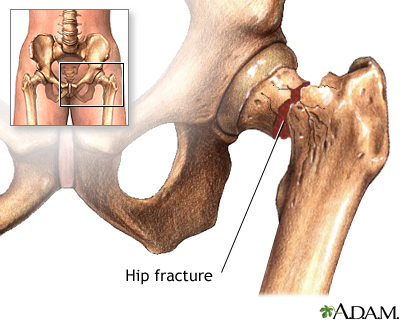
- Most importantly, the broken hip: Before I was in medical school, I guess I'd never really thought about what exactly a broken hip was. I just figured it meant that you broke your pelvis bone or something. For example, if someone asked me to point to my hip, I'd have pointed to my anterior superior iliac spine (I know, sounds fancy...they like to teach us big words in medical school). Last year I learned that when a person breaks their hip, it actually means that they have broken the top of their femur bone. Hip fractures are more common in older people and carry a 30% one-year mortality rate (one of the highest mortality rates of any acute medical condition/surgery). It's not that the actual hip fracture or surgical repair itself is particularly risky, it's just that a hip fracture is a marker of poor health. That is to say, people who get hip fractures are in poorer health than those who don't get hip fractures, so naturally, they have a higher rate of mortality.
- No history of heart disease or failure.
- No history of renal disease or failure.
- Minimal medications.
- Surgery
- Surgery
- Surgery
- Medical management: Appropriate only if life expectancy is less than one month. Consists of pain management and treatment of other medical problems. Studies have shown that if patients are expected to live longer than one month, despite their hip fracture, it is best to go ahead with surgery and try to get them as healthy as possible.
I entered Ms. H.'s room and performed my detailed history and physical exam. I don't need an "MD" behind my name just yet to say that in even just looking at Ms. H., I knew she wasn't a great surgical candidate. Honestly, I didn't even need to set my stethoscope on her chest to tell you the findings of her lung exam: increased work of breathing with minimal air movement, inspiratory and expiratory wet crackles in all lung fields bilaterally. There was a specimen cup on the bedside stand half-full of thick yellow-green sputum: this was normal for her.
She would chuckle a raspy laugh as I asked her questions like, "how long have you had your cough?" and "what makes you feel like you can't catch your breath?". I felt silly asking these routine questions when I knew how they must have sounded rhetorical. I know she was laughing at my questions, but she was sweet and just said, "oh honey, I don't know". When I asked her what happened, she said she had gotten up in the night to go to the bathroom and when she returned to bed, she "just misjudged the distance to the bed" and fell. Immediately, her right hip and leg were in pain and she was brought to the hospital that morning. She said she wasn't in much pain now and that she was as comfortable as she could be.
I explained that she would probably need surgery and that Dr. Cuskelly and myself were going to be looking after her medical issues during her hospital stay. I told that we were concerned about her lungs and wanted her to practice deep breathing with the incentive spirometer and continue to use her inhaler and oxygen. I informed her and that we were getting routine chest x-rays, and running sputum, blood, and urine cultures to check for any signs of infection so that we could treat those before she became symptomatic. I also let her know that we were concerned about her anemia and malnutrition. We could not feed her until after the surgery, but we would give her 2 units of pRBCs (packed red blood cells) now and make sure the dietitians saw her and made recommendations for us.
She indicated that she understood, then I told her I needed to clarify one more thing with her: "Ms. H., I need to know what you would want us to do should your heart stop or if you stopped breathing on your own."
"Just let me go. I don't want CPR. Everything else, just no CPR."
I was confused. I didn't know what she meant by 'everything else'. "Okay, Ms. H. I just want to make sure we are understanding each other. I know you don't want CPR, or chest compressions, if your heart stops," I made the hand motions on my own chest, "but what about if your heart is still beating and you stop breathing?? Would you want us to intubate you? I mean, to breath for you or put something down your throat to help you breath? I am only asking because I want to make sure we do what you want. Do you understand that CPR is different that ventilation?" Again, I was making hand motions; this time to my mouth and throat mimicking intubation.
It then occurred to me that in just 2.5 short years I was already beginning to speak the foreign language of doctors that separates them from patients (keeping in mind that this is a very basic example...fairly straight-forward and relatively easy to clarify without too much jargon, but none-the-less a hurdle we must overcome). We write DNR/DNI (do not resuscitate/do not intubate) orders every day. Those abbreviations mean two very different things to us, but to a patient (or any non-medical person), it's all just CPR. And what exactly does "CPR" mean to any non-medical person? That may have a variety of different meanings to different people. And then to confuse matters worse, we start using words like "intubation" and "ventilation" to folks that are 1) sick, under stress, and possibly confused, and 2) elderly and hard of hearing...not the most ideal setting for making informed decisions. How do I know that what I am saying is what she is understanding? Or what she is saying is what I am hearing? And how do all these issues of semantics impact the doctor-patient relationship? Am I inadvertently adapting the "us and them" mentality that so many river guides use to intentionally separate themselves from guests?
"Oh, honey, I don't want anything that has to be long term. No CPR. No tubes if it has to be for a long time. If it's my time to go, then let me go. I'm ready."
"Okay, I understand." I said as I gently patted her leg, held her hand and mentally wrote down "DNR/DNI".
____________________________________________________
The next morning I went in to check on her. She looked the same, but her lungs sounded worse. I told her the surgery would probably happen in the afternoon and that I would be there for it and, although I wouldn't be in the hospital through the weekend, that Dr. Cuskelly and myself would be looking after any medical issues she might encounter after the surgery. She chuckled her wet laugh and said, "That's good. I like Doctor. He's a good man."
"Yes, he is," I agreed, "and a good doctor." In the back of my mind I wondered if she would be around when I returned to the hospital Monday. I don't mean to be morbid, cold, or insensitive, I just didn't think she had a lot of "reserve" to tolerate the stresses of a surgery and I wasn't going to lie to myself about her prognosis.
____________________________________________________
That afternoon I saw my first orthopedic surgery. I waited with Ms. H. outside the OR for Dr. Urvater to arrive. I held her hand and asked her how she was going. It was difficult to understand what she was saying: her lungs were sounding worse. The coughing and airway congestion were interfering with her speech. She looked scared and asked one of the nurses to pray with her, but this didn't bring her heart rate down. When Dr. Urvater arrived, we went into the OR, got her prepped, and anesthetics started. This operation might normally require general anesthesia, but because of her poor lung function and inevitably difficult post-op extubation, a local spinal block was used along with sedative narcotics for pain and amnesia.
Dr. Urvater is married to Dr. Camber, but while she is very outgoing and bubbly, he is very level and restricted. I guess opposites attract. This isn't to say anything bad about him: he's very nice and also willing to teach me, just with a little less enthusiasm, I guess. Anyway, it was amazing to see this operation. A small incision is made on the upper outer thigh. The layers of muscles are dissected away to reveal the trochanter of the femur broken away from the head. The head is taken out and the shaft of the femur sawed down. Prosthetic components (ball and socket) are measured and fitted. Marrow is taken out of the shaft, inner diameter is measured, cement is mixed, and it's all put back together. (Note: this is a very simplified description...I left out a bunch of technical stuff and lots of hammering and chiseling).
Through the operation, her heart rate remained elevated, but she otherwise did well. No problems with breathing or maintaining O2 saturation. I visited with Mark, the anesthetist for a long time afterwords. He was teaching me about different medications and concerns he was watching for in the post-op hours. He confirmed that she was high-risk and that he was concerned; he would be keeping a close watch on her.
When I left the hospital Friday, I felt better about her outlook. Things went well in the operation: no surgical complications, no lung problems, no need to intubate her for anesthetic purposes, minimal blood loss, no heart problems, no blood pressure problems. I was actually pretty optimistic. I called Aaron and told him about the surgery and I was excited to have the privilege to care for Ms. H. and also see her surgery.
____________________________________________________
I was called in by Dr. Ercanbrack, the general surgeon, this morning to assist on a appendectomy. When I arrived to the OR I saw Mark, the anesthetist: "So I guess you probably heard by now that Ms. H. died yesterday."
I hadn't heard. "No," I said, "that's too bad." And it was. I felt my heart drop a little, but I wasn't surprised, just sad and disappointed to hear it.
Then there is always the questioning: Did we do the right thing? What could we have done differently? Did I miss anything? Should we have provided "comfort care" rather than perform surgery? Medicine is a scientific field: we like patterns, certainty, predictability, and answers. But it is also an art: a balancing act where we consider each patient as an individual and every situation is different without right, wrong, or clear decisions and answers. I'm learning that at the end of the day, we can't question our decisions to the extent that we become paralyzed. We must trust our knowledge, training, clinical judgement, and experience to guide us in making the right decision, and as Bob Campbell used to tell me before a kayak race, "let the results take care of themselves". Experiences such as this makes me appreciate the seemingly endless hours and years of studying and training it is taking me to get those two letters behind my name: it's so that I will one day have the knowledge, training, clinical judgement and experience necessary to guide me. I will have to learn to trust my decisions and live with unanswered questions because I won't always know "what if..."
___________________________________________________
*for patient confidentiality purposes, I will use pseudonyms when I recount patient stories
Sunday, February 8, 2009
A "glorious day" that was "sweet, sweet, sweet" on Flatiron Mountain
Dr. Cuskelly was kind enough to show me around in the back country a bit this morning. We drove about 25 miles northwest out of town on FS road 567, which later turns into FS road 68 toward the Yaak valley. The hike up Flatiron Mountain is probably close to 2 miles and maybe 1500 vertical (keep in mind I'm not too great with estimating distance or height). We got out of the gloom in Libby (which was socked in an inversion this morning), got some fresh air in our lungs, and had what Dr. Cuskelly repeatedly declared to be "a glorious day" with turns that were "sweet, sweet, sweet!". It was!
The Trailhead:

Dr. Cuskelly: My apologies for not getting a face shot.
We had a great time hiking, visiting, and getting to know one another. He is originally from Washington, but moved to Alaska after high school. He spent some time living in the back country there and said he got into medicine when he started volunteering at the local fire station so that he could have a weekly shower as his shack in the woods was without plumbing! One thing lead to another and he found himself in the Alaska WWAMI program. He did his Family Medicine Residency in Ogden, Utah and said that he always knew he wanted to be a rural doctor. He originally thought he'd go back to Alaska, but realized that he didn't want to raise his twin sons and daughter that far in the back country. A rural rotation in his third year of residency brought him to Libby. He hit it off with the doctors here, was offered a job, and the rest is history: he's been here ever since.
We talked a lot about having a love for the outdoors, medicine, and trying to balance your life between the two. He acknowledged the difficulty of doing that and advised me that whatever I decide to do, I should always remember to consider what I want my lifestyle to be. "Medicine is a seductive mistress," he concluded, "no matter what field you end up going into, you have to be careful or you'll find yourself totally consumed by her."

Hiking up:
Dr. Cuskelly lead the way, with occasional breaks long enough to say something like, "Do you mind if we go at a slow pace?"..."I only got 4 hours of sleep last night because I was playing music; I'm really hurtin' today"..."I'm really dragging today, but I'm glad I got off my ass!"..."I'm getting too old for this". I interpreted some of these comments to mean he may have had a little too much fun last night (I'm sure you know what I mean). It was a good thing for me, though, because his pace was just right for an out-of-shape, been living at sea level girl suffering from short-leg syndrome. Honestly, now I'm a little nervous to go hiking with him when he's not hurtin'.

Looking North:
Canada in the distance and the Yaak valley in the haze
Looking East:
Glacier Park

Looking Southeast:
The back side of Turner Mountain and Libby in the valley fog

Looking South:
The Cabinet Mountains

Looking West:
Idaho and the Selkirk Mountains in the distance
Seventeen Mile Creek headed towards the Yaak River in the valley in the foreground

Roderick Mountain

The Trailhead:

Dr. Cuskelly: My apologies for not getting a face shot.
We had a great time hiking, visiting, and getting to know one another. He is originally from Washington, but moved to Alaska after high school. He spent some time living in the back country there and said he got into medicine when he started volunteering at the local fire station so that he could have a weekly shower as his shack in the woods was without plumbing! One thing lead to another and he found himself in the Alaska WWAMI program. He did his Family Medicine Residency in Ogden, Utah and said that he always knew he wanted to be a rural doctor. He originally thought he'd go back to Alaska, but realized that he didn't want to raise his twin sons and daughter that far in the back country. A rural rotation in his third year of residency brought him to Libby. He hit it off with the doctors here, was offered a job, and the rest is history: he's been here ever since.
We talked a lot about having a love for the outdoors, medicine, and trying to balance your life between the two. He acknowledged the difficulty of doing that and advised me that whatever I decide to do, I should always remember to consider what I want my lifestyle to be. "Medicine is a seductive mistress," he concluded, "no matter what field you end up going into, you have to be careful or you'll find yourself totally consumed by her."

Hiking up:
Dr. Cuskelly lead the way, with occasional breaks long enough to say something like, "Do you mind if we go at a slow pace?"..."I only got 4 hours of sleep last night because I was playing music; I'm really hurtin' today"..."I'm really dragging today, but I'm glad I got off my ass!"..."I'm getting too old for this". I interpreted some of these comments to mean he may have had a little too much fun last night (I'm sure you know what I mean). It was a good thing for me, though, because his pace was just right for an out-of-shape, been living at sea level girl suffering from short-leg syndrome. Honestly, now I'm a little nervous to go hiking with him when he's not hurtin'.

Looking North:
Canada in the distance and the Yaak valley in the haze

Looking East:
Glacier Park

Looking Southeast:
The back side of Turner Mountain and Libby in the valley fog

Looking South:
The Cabinet Mountains

Looking West:
Idaho and the Selkirk Mountains in the distance
Seventeen Mile Creek headed towards the Yaak River in the valley in the foreground

Roderick Mountain

Annie Being Herself
The first picture you've seen of me in Libby!

It's hard to do a buddy shot with a dog, especially Annie dog.

Goofy pictures of Annie being herself:


It's hard to do a buddy shot with a dog, especially Annie dog.

Goofy pictures of Annie being herself:


Saturday, February 7, 2009
Have You Ever Cut Before?
Thursday:
Dr. Cuskelly told me to be to the hospital around 7:45 because he was assisting Dr. Camber (the OB/GYN in town) with a C-section. He told me that "she usually flies though" C-sections and that if I blink I might miss it unless she was in a teaching mood in which case, she'd probably let me be the first assist. That was exciting news, but here's what happened when I showed up to the OR:
Emily to Nurse: "Hi, I'm Emily, the new medical student." (Keep in mind this phrase just rolls off my tongue these days). "I'm working with Dr. Cuskelly. He told me to let you know my glove size because we are scrubbing in on the C-section to assist Dr. Camber."
Nurse to Emily: " Dr. Cuskelly is going to be the baby's doctor. That means you won't be scrubbing in, you'll just watch and then leave once the baby's delivered. I will assist Dr. Camber."
Emily to Nurse: "Oh....well, okay." I knew that was wrong, but I'm Emily, the new medical student, and I am not about to piss off the nurses.
In walks Dr. Camber. I've never met her, but I know it's her. She's a tall, slender, attractive woman in her mid-40's (??) with sandy blonde hair in a ponytail.
Dr. Camber to Emily: "You must be Emily. Nice to meet you, I'm glad you want to scrub in for this today, what's your glove size?"
Emily to Dr. Camber: "6.5."
Dr. Camber to Nurse: "Can you get her a pair of 6.5's? She and Dr. Cuskelly are helping me today."
Nurse to Dr. Camber: "Oh....I thought Dr. Cuskelly was the baby doctor. He can't assist you if he has to leave and take care of the baby."
Dr. Camber to Nurse: "Well, if there are problems with the baby and he needs to leave, I'll still have Emily to help me."
Nurse to Dr. Camber: "So....do you need me to scrub in?"
Dr. Camber to Nurse: "No, I don't think so. It would be too crowded with four of us in there plus the scrub nurse. You can stay scrubbed out."
And that was that. Immediately Dr. Camber started talking to me and asking me how much I've done in an OR. I told her I've only sewn fascia and skin. She says, "Oh, well I'll let you do more than that if you want. Have you ever cut before?". I tell her no.
She started teaching me how to cut with a scalpel, surgical scissors, etc. She starts walking me through the whole operation and what to do/expect and then says, "I'll just let you do as much as you can do. When you can't go anymore or you start having problems, I'll take it from there. Don't worry, I'll walk you through the whole thing, but I'm going to do it quietly so we don't freak out the patient and her husband. Sometimes teaching during surgery makes people nervous." (No shit, I'm thinking). I was floored! I just met this woman, more importantly, she just met me and she's telling me I can do the surgery?!
We get scrubbed in and gowned up and I'm standing there about to drape the patient and I suddenly feel a little light-headed and queezy. I haven't felt like this in an OR since the first time I scrubbed during my surgery rotation in September. My heart is pounding and I'm nervous because I know I'm going to be doing the surgery. The sucker that is normally in my left hand will be replaced by a #15 scalpel. One thought crosses my mind: I should have eaten a bigger breakfast.
We get all set up and she hands me the scalpel. "Um, I'm a lefty." I admit. "Should we be on the other side of the patient, or does it matter?"
Dr. Camber takes a minute to think. "Okay everyone, we're switching sides, she's a lefty and needs to see what she's doing when she delivers the baby." And just like that, the entire room reversed and I was cutting. The next hour was incredible. It was a bit of a blur and at the same time crystal clear. She walked me through all the layers, gently guided my hand when necessary, and constantly encouraged me. Occasionally she'd look at Dr. Cuskelly and say something like, "Well, this part would be easier if your assistant was paying attention", somewhat joking with him. Through the entire thing I stayed calm and didn't even think about the father (who is a physician) standing 2 feet from me scrutinizing my every move. I didn't feel a rush until it was all done and we walked out of the OR. I'm sure I was glowing. I felt like I was floating the rest of the day; totally on cloud 9.
I ran into the father in the hall later in the day, "Emily, that was a fabulous job you did in there. Very impressive." Then Dr. Camber, "You did amazingly. Did you say you've never operated before? You are welcome to come in on any of my cases while you are here." Later Dr. Becker, the radiologist, "You know Dr. Camber was raving about you; she said she was very impressed--said you were a natural and couldn't believe that was the first time you've done that."
I think I'm still glowing and can't help but grin when I think about it.
Week One: In Review
This week has just flown by; I'll try to recap the highlights.
I've found that the first few weeks of any rotation is always a bit of a blur with trying to figure out all the new people, new clinic, new hospital, etc. It seems like by the time I get feeling comfortable, the rotation is half over. Maybe I'm getting better at making the transition through rotations or maybe I'm just where I'm supposed to be (doing WRITE, being in Libby, etc) because it's only been one week and I feel more on top of how things run, what my role is, and what the expectations are than I ever have after this short of time in my other rotations. That isn't to say that I have things completely figured out, but I just feel like the learning curve is a little less steep in terms of getting settled into this new rotation.
Most days start between 7:30 and 8:00 at the hospital. I follow patients who get admitted when I'm on call. Because my first call day wasn't until last night (Friday), I just picked up two of Dr. Gunther's patients on Monday since I was working with her for the first part of the week. I round on my patients (or as they say in Libby and Caldwell, I "make rounds"), which means that I look at their charts to see what happened in the last 24 hours and then I visit with the patients, check out any lab, radiology, or pathology results, see how they are feeling, and do a physical exam. Then I write a daily progress note with my assessment of how they are doing and plan for the day. I write orders (i.e. medication changes, labs that need to be ordered, IV fluids, diet, activity, etc) and then discuss my plans with the supervising physician. We talk about the things we agree about and inevitably, I miss something or get something wrong, so we discuss that and make any necessary changes (as a side note, our Medicine Clerkship director in Seattle told us that third year medical students are experts and getting things wrong, so I guess I'm right on track).
When we are done at the hospital (usually around 9:30) we walk over to the Libby Clinic to start seeing patients. I am assigned to one of the doctors each week and see patients with them. The schedule is flexible, though, and sometimes I see interesting cases, pediatric, or OB patients with any of the doctors who have those patients on that day. Generally, I will see a patient first by myself: interview them, see why they are there, discuss health maintenance, and do a physical exam. After that I grab the real doctor and we go back into the exam room where I present my findings to them and we have a discussion with the patient and make a plan together. After the patient leaves, the docs take a little time to teach me a few things, I write the note in the chart, and repeat!
Each doctor does things slightly differently and their schedules have some daily variations, so I have to stay flexible as I work with each of them. For example, Dr. Rice only uses the computer to write patient notes. He takes his laptop in the room so that he can have access to all their chart information. Dr. Gunther, on the other hand, doesn't really know how to use a computer. She is the only doctor I've met this year that still uses a hardcover PDR (Physician's Desk Reference: a reference for drug indications, dosing, side effects, contraindications, etc that looks a lot like Mom's Webster's Dictionary, only fatter!). There are a lot of electronic resources for this these days, which are available both online and in PDA versions that make looking up this information so fast and easy. As you might imagine, she doesn't use the computers to do electronic charting, so she orally dictates all the notes on the patients. This is fast for her, but very slow for me; I'm much more comfortable writing a patient note on the computer. She laughs about it says she knows she needs to learn and that she will try to learn enough so that she can find my notes on the computer to review them. Everyone in the office tells me, "good luck", with getting that to happen. We'll see.
The office takes a lunch break from 12:30 to 1:30. This is the first time all year I feel like the docs actually take a break on the lunch hour, which is great; I don't feel like I have to grab a Cliff bar between patient visits. I usually try to get home and let Annie out for a quick pee break, fix some hot tea, and eat real food before heading back to the office for the afternoon patients. It varies each day when we get done, but it's usually between 5:30 and 6:30. Most evenings I come home to take care of Annie, fix dinner, and do some reading/studying. I joined the Montana Activity Center (MAC) and am trying to go a few times a week. This week I only made it there on Wednesday for Pilate's and Thursday for my spinning class.
Here are my highlights of the week!
Monday/Tuesday:
I worked with Dr. Gunther these days. She is probably in her 50's and is certified in both Family Medicine and Internal Medicine. Her favorite patient population is geriatrics (just like me!). We see eye-to-eye on this and that is that they:
1) have great stories and are fun to talk to...we both want to record oral histories
2) are so cute
3) if they aren't cute, they are crotchety, obstinate, and VERY entertaining (that one isn't hers, but it's mine!)
Dr. Gunther is so happy and kind and always smiling. You can tell that her patients just love her and she loves them too. Tuesday morning we made rounds at the Libby Care Center (aka, nursing home) and met some very sweet ol' folks. One little old lady is blind and nearly deaf told Dr. Gunther, "you look so young and beautiful today! I'm so glad to see you, thank you for visiting," and then gave her the biggest hug ever. She also told me I looked young and that she was glad to meet me and gave me an equally big hug. She was just so happy and full of life and it really made my day. Another man told us that living there wasn't the best, but it was better than not because they gave him a button that when he pushes it calls a lovely nurse in; if he had that button at home, nobody would come. He was also very sweet and had a great sense of humor.
Wednesday:
I worked with Dr. Rice in the morning and Dr. Cuskelly in the afternoon. Dr. Cuskelly is also probably in his 50's. He was an Alaska WWAMI student and really believes in the WRITE program as a great way to train third year students. I worked with him the rest of the week and really enjoyed our time together. He is a great teacher, but pushes me to make decisions regarding patients. Dr. Cuskelly performed a circumcision in the office that afternoon. He walked me through all the steps and told me about the different techniques and the pros and cons of them and why he uses the technique he likes. He told me I can do the next one!
Thursday:
This day deserves it's own post....stay tuned.
Friday:
I was on call with Dr. Cuskelly on Friday. At first I was really bummed because I was spending all day at the hospital admitting patients and missing clinic. Then I realized that I was admitting patients! Not an attending, not an R3 (third year resident), not an intern. ME! An MS3 (3rd year medical student). The nurses would ask me things like, "Can we give Mr. X more percocet?", "When do you want us to start the IV antibiotics, and how fast do you want the IV fluids to run?", and "Would you like me to adjust the patient's oxygen up now or wait?" And then I would hesitantly answer with a question, "Sure?", "Umm...let's start them now and how about 100cc/hour?", "Uhh..adjust it up now?" They would run off and start doing it with hardly enough time for me to yell after them, "You should probably check with Dr. Mahoney first!!" It is the weirdest thing to feel like I know NOTHING and lack confidence about decisions that need to be made and then have people look to me first and then actually DO what I say. It's a little overwhelming, but also very cool. I finally feel like I'm doing something useful this year: I'm actually making decisions. Even the doctors ask me what I want to do with patients, and then say, "Okay."
My other triumph of the day: learning how to use the dicta-phone and seeing my dictated note magically appear in the patient's chart with the doctor's barely legible hand written note at the bottom: "Patient was seen and examined by myself and I agree with the above assessment and plan of Ms. Beck, MS3".
Wow! That was one long post. Is anyone even still reading? I don't expect that'll happen again...I'll lose my audience if I keep that up.
Subscribe to:
Posts (Atom)